
TL;DR: Nearshore software development means working with developers in nearby time zones (0-6 hours difference) — Eastern Europe for European companies, Latin America for US companies. Senior developer rates run $55-80/hour in Poland, 40-60% below Western European rates. The model works when the firm has proper management infrastructure, not just cheap talent. Key contract terms: IP ownership, replacement clauses, GDPR coverage by location, and defined escalation paths. Onboarding takes 2-4 weeks with a prepared partner.
You have open engineering roles. You've been trying to fill them locally for months. You know talent is available in Eastern Europe, Latin America, or Southeast Asia. But you're not sure whether nearshore development is a legitimate long-term model or a shortcut that creates new problems.
This guide is a direct answer to that question — how nearshore software development actually works, what it costs in current market conditions, and the mistakes that make engagements fail within the first year.
What Is Nearshore Software Development?
Nearshore software development means building your product or scaling your engineering team with developers from a geographically close region — typically within 0-6 time zones of your company.
For US companies, "nearshore" usually refers to Latin America: Mexico, Colombia, Argentina, Brazil. For Western European and DACH companies, it means Central and Eastern Europe: Poland, Ukraine, Romania, Czech Republic.
The time zone proximity is the key differentiator from offshore. With a nearshore team in Poland (UTC+1/+2), a team in Zurich or Frankfurt has a full working day overlap. A US East Coast team working with Colombia (UTC-5) shares 5-6 hours of overlap. With an offshore team in India or the Philippines, real-time collaboration requires scheduling around a 9-13 hour gap.
Nearshore isn't simply a geographic label — it's a delivery model that only works as intended when the firm has invested in the process infrastructure to manage it: communication protocols, onboarding procedures, legal frameworks that cover all delivery locations, and management accountability that doesn't disappear after the contract is signed.
Why Companies Choose Nearshore Development
The primary driver is the structural talent shortage in Western markets.
In Germany, over 100,000 IT positions remain unfilled. The average IT role takes months to fill, and the vast majority of German companies report difficulty finding qualified candidates. Switzerland and Austria face comparable conditions. US tech companies are competing for the same senior engineering talent across every growth sector simultaneously.
Eastern Europe has a substantial pool of software developers, with Poland, Ukraine, and Romania as the three largest talent markets. Poland consistently ranks among the top countries in independent coding assessments, and the majority of Polish IT professionals have strong English proficiency.
The alternative — waiting out a multi-month local hiring cycle while your product roadmap slips — has a direct business cost that's easier to feel than to measure.
Nearshore vs. Offshore vs. Onshore: An Honest Comparison
Most comparisons of these models are written by firms with a stake in one answer. Here's an attempt at a neutral breakdown.
| Nearshore | Offshore | Onshore | |
|---|---|---|---|
| Time zone overlap | High (0-6 hrs difference) | Low (6-13 hrs difference) | Full overlap |
| Real-time collaboration | Easy | Requires scheduling | Easiest |
| Cost vs. local rates | 40-60% lower | 50-75% lower | Same as local |
| Talent pool depth | Large (Eastern Europe 1.75M+) | Very large (India, Philippines) | Limited by local market |
| Cultural alignment | High (CEE ↔ Western Europe/US) | Moderate | Full |
| IP/compliance complexity | Moderate (requires proper contracts) | Higher | Low |
| Onboarding time | 2-4 weeks (good partners) | 2-6 weeks | 4-8 weeks local hire |
| Geopolitical risk | Moderate (CEE; mitigated by multi-location) | Low-moderate | Low |
The honest conclusion: nearshore offers the best balance for most European and mid-sized US companies. Offshore wins on pure cost. Onshore wins on zero complexity — but is increasingly impractical for companies trying to scale engineering at speed.
The right model depends on what you have internally. If your CTO can manage an asynchronous distributed team, offshore becomes viable. If you need real-time collaboration on a fast-moving product, nearshore is the pragmatic choice.
What Nearshore Software Development Actually Costs
Cost data in this space is often misleading because it mixes hourly rates with total engagement cost. Here are the actual figures for current market conditions.
Engineering rates by region
Poland senior software engineers: $55-$80/hour (fintech and ML specialists command $80-$95/hour). Ukraine senior engineers: $40-$60/hour. These figures reflect current market rates from industry benchmarks.
Comparison with local markets
Hiring a mid-level software developer directly in Germany costs approximately €80,000+ per year in total employment cost — salary plus employer contributions. At a senior level in Germany or Switzerland, total employment cost regularly exceeds €130,000 annually.
Nearshore engagements in Eastern Europe typically run 40-60% below equivalent Western European rates, and 50-75% below equivalent US rates — depending on the specific country, seniority mix, and engagement model.
What drives the actual bill
The rate itself is only part of the equation. Add:
- Management fee (if the firm has a management layer — which is worth paying for)
- Equipment and setup costs (good firms handle this; check who pays)
- Onboarding time (the first 2-4 weeks are productive but not at full velocity)
- Potential replacement cost if the first candidate isn't the right fit
The right question isn't "what's your hourly rate?" — it's "what's the total cost of getting a productive, retained engineer working on my product?" A $45/hour developer who underperforms and leaves after three months costs more than a $70/hour developer who delivers consistently for two years.
Indicative monthly costs by profile
| Profile | Poland | Ukraine | Germany (local hire) |
|---|---|---|---|
| Mid-level developer | $6,500-$9,500/mo | $5,000-$7,500/mo | ~€10,000-€12,000/mo |
| Senior developer | $9,000-$14,000/mo | $7,000-$11,000/mo | ~€13,000-€18,000/mo |
| Tech lead | $12,000-$17,000/mo | $9,000-$14,000/mo | ~€15,000-€22,000/mo |
Monthly rates are indicative; actual rates depend on stack, domain expertise, and engagement model. Management fees, if applicable, are separate.
The Most Common Nearshore Development Mistakes
The failure rate in distributed engineering engagements is real. Most failures are predictable — and preventable.
Mistake 1: Choosing based on rate alone
The lowest-cost provider rarely has the investment in talent quality, screening processes, and management infrastructure required for a reliable long-term engagement. When price is the selection criterion, you're selecting for margin optimization on the firm's side, not delivery quality on yours.
Mistake 2: No defined escalation path
"Reach out to your developer on Slack" is not a management model. Before signing, you should know: who at the firm do you contact when something goes wrong at a bad time? What is the defined response time? What happens if your primary contact leaves the firm?
Mistake 3: Starting without a defined project scope
A nearshore team can execute effectively on a clear brief. Without one, miscommunication compounds across time zones and async communication channels in ways that don't surface immediately but create significant rework cost. Before onboarding a nearshore team, your engineering leadership should be able to articulate the first 90 days of work with specificity.
Mistake 4: Treating compliance as a legal formality
IP ownership, GDPR coverage for the specific delivery locations (Poland's GDPR implementation differs from managing data handling for a team in Ukraine), NDA structures, and data residency requirements — these aren't boilerplate. They require explicit attention in the contract, not a generic "we're compliant" assurance. For regulated industries, the compliance framework is a threshold question, not a nice-to-have.
Mistake 5: No replacement clause
Developer churn happens. The question is whether it's a crisis or a managed process. A contract without a defined replacement clause — specifying timeline, process, and cost responsibility — means you're negotiating from a weak position when you can least afford it.
Mistake 6: Insufficient onboarding investment
A nearshore developer joining your team needs what any new team member needs, plus more: explicit documentation of your architecture, coding standards, deployment processes, and communication norms. Teams that treat nearshore onboarding as identical to in-office onboarding consistently underperform for the first 60-90 days.
What Should Be in a Nearshore Development Contract
A contract that protects you in a nearshore engagement should address these specifically:
IP ownership — All intellectual property created during the engagement belongs 100% to the client, from the moment it's created. This should apply to the engineers directly, not just through the firm.
Data handling and GDPR — Location-specific coverage: which data processing agreements apply per delivery country, who is responsible for compliance at each location, and what happens if a delivery location changes.
NDA scope — Applies to all team members, not just the management layer. Includes client confidentiality, source code, and business information.
Replacement clause — Defines the process and timeline if a developer leaves or underperforms. A reasonable benchmark: replacement initiated within 5 business days, completed within the same timeframe as original onboarding.
Onboarding timeline — Specifies when the engagement starts, when the first candidate is presented, and when the developer is expected to be productive.
Termination terms — Notice period, handover obligations, and what happens to code and documentation at contract end.
Escalation path — Named contacts at the firm, defined response times, and the process for resolving disputes.
If a firm pushes back on any of these as "standard clauses," ask why their standard clauses differ from what you've outlined.
How Onboarding a Nearshore Developer Actually Works
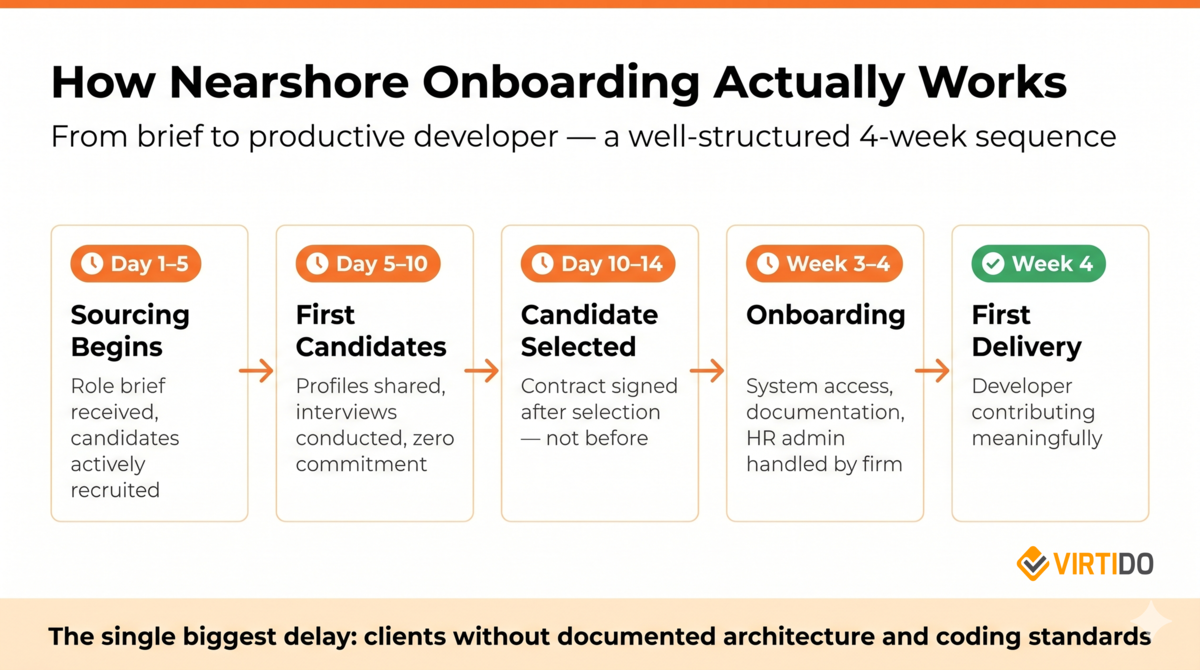
A well-structured nearshore engagement follows a defined sequence. Here's what the first four weeks typically look like with a prepared partner:
Days 1-5: Sourcing begins
The firm receives the role brief and starts sourcing against specific criteria. With individual sourcing (as opposed to bench staffing), candidates are actively recruited for your role, not pulled from pre-employed developers.
Days 5-10: First candidates presented
Profiles are shared for client review. You assess CV and conduct technical and cultural fit interviews — no commitment required at this stage.
Days 10-14: Candidate selection
You select a candidate. Contract is signed. Notice period (if applicable) begins.
Week 3-4: Onboarding
The developer receives access to your systems, documentation, and codebase. The firm handles equipment, payroll setup, and HR admin. Your engineering lead conducts technical onboarding sessions.
End of week 4: First delivery
A well-prepared nearshore developer should be contributing meaningfully by end of week four — not necessarily at full velocity, but not a pure cost center either.
This timeline assumes the client has documentation ready. The single biggest cause of delayed productivity is clients expecting the developer to "figure it out" from a codebase with no documentation.
Timezone Reality: What to Expect from Poland and Philippines for US Teams
Poland (UTC+1 / UTC+2 in summer)
For US East Coast teams (UTC-5): 6-7 hours difference. You have 1-2 hours of overlap at the beginning of the European day and the end of the US morning. Real-time collaboration is possible but requires deliberate scheduling. Morning standups at 9am Warsaw = 2-3am New York — unrealistic. 4pm Warsaw = 9-10am New York — workable for daily sync.
For US West Coast teams (UTC-8): 9-10 hours difference. Asynchronous work is the realistic model. Evening standups or early morning US can provide a small overlap window.
Philippines (UTC+8)
For US East Coast teams: 12-13 hours difference. Real-time collaboration requires either very early US mornings or late Philippine evenings. This is a genuine offshore time zone, not nearshore — manage expectations accordingly. The Philippines works as a nearshore destination for Australian and some Southeast Asian companies.
Practical implication
For US companies, Eastern Europe (Poland, Ukraine) is nearshore in geographic terms but significantly asynchronous in practice for West Coast teams. The model works well when the firm has a management layer in a more compatible time zone — or when the client team has a process that runs effectively on async communication and documented handoffs.
Working with Virtido on Nearshore Development
Virtido operates from Poland (Wroclaw) and Ukraine (Lviv, Kyiv, Ternopil) as primary Eastern European delivery locations, with the Philippines (Manila) as a complementary option for clients needing Southeast Asia coverage.
The management layer is Swiss — legal contracts, IP ownership, GDPR framework, and client relationship all operate under Swiss jurisdiction when contracts are structured accordingly. For clients in regulated industries (financial services, healthcare), this is a meaningful structural difference from firms managed entirely from delivery countries.
The engagement starts with free sourcing and candidate interviews — no commitment required before you've seen and spoken with the specific developers who would work on your team. Onboarding runs 2-4 weeks from contract signing to a productive, working developer.
Multi-location delivery (Poland + Ukraine, or Eastern Europe + Philippines) is available for clients who want to distribute geopolitical risk or need extended timezone coverage.
Making Nearshore Work
Nearshore software development is a proven model when executed with the right structure. The firms that deliver consistently have invested in management infrastructure, compliance frameworks, and replacement processes — not just access to cheaper talent markets.
The questions in this guide aren't designed to disqualify vendors. They're designed to surface the difference between firms that have solved the operational challenges of distributed engineering and firms that are hoping you won't notice the gaps until after you've signed.
Get the contract terms right. Invest in onboarding. Expect 2-4 weeks to productivity, not immediate output. And verify that the firm's management layer has actual accountability — not just a sales function that disappears after the deal closes.
Frequently Asked Questions
What is nearshore software development?
Building your product or scaling your engineering team using developers from a geographically close region — typically within 0-6 time zones. For US companies, this usually means Latin America. For European companies, it means Central and Eastern Europe.
How much does nearshore software development cost?
In Eastern Europe, senior developer rates run approximately $55-$80/hour in Poland and $40-$60/hour in Ukraine. This is typically 40-60% below equivalent Western European rates and 50-75% below US market rates. Total engagement cost also depends on management fees, equipment, and onboarding.
Is nearshore development the same as outsourcing?
Nearshore development is one model within IT outsourcing. The distinction that matters more than the label is whether the firm sources individually for your role or assigns from a pre-existing bench, whether there's an accountable management layer, and whether the contract properly covers IP, compliance, and replacement.
What's the difference between nearshore and offshore?
Time zone alignment. Nearshore means 0-6 hours difference — overlapping working hours with the client, enabling real-time collaboration. Offshore typically means 6-13 hours difference, which makes synchronous collaboration difficult and requires strong async processes. Nearshore costs slightly more than offshore but saves significant coordination overhead.
How long does it take to onboard a nearshore developer?
With a well-prepared partner: first candidates presented within 3-5 business days, contract signed after candidate selection, developer fully onboarded and contributing within 2-4 weeks. Firms relying on bench staffing may be faster to present candidates but typically slower to deliver productive work.
What time zones do Eastern European developers work in?
Poland and Ukraine are UTC+1 (winter) / UTC+2 (summer). For US East Coast teams, this means 6-7 hours difference — manageable with deliberate scheduling. For US West Coast teams, the gap is 9-10 hours, making asynchronous work the practical default.
What happens if a nearshore developer leaves mid-project?
This should be defined before you sign the contract. A reliable partner specifies: replacement initiated within 5 business days, completed within the same timeframe as the original onboarding. A firm that deflects this question hasn't solved the problem structurally — and you'll be negotiating from a weak position if it happens.
What should be in a nearshore development contract?
Key terms include: 100% IP ownership from creation, location-specific GDPR coverage, NDA scope covering all team members, replacement clause with defined timelines, onboarding milestones, termination terms with handover obligations, and named escalation contacts with response times.
Which countries are best for nearshore development from Europe?
Poland, Ukraine, and Romania are the primary nearshore destinations for European companies. Poland has the largest talent pool (650,000+ IT professionals) and strong English proficiency. Ukraine offers competitive rates. Romania provides EU membership and Latin-language cultural alignment. Multi-location strategies can mitigate geopolitical risk.
How do I evaluate a nearshore development company?
Focus on the delivery model, not the pitch. Key criteria: individual sourcing vs. bench staffing, who manages engineers after onboarding, replacement SLA, compliance infrastructure by location, onboarding timeline, and whether you can interview candidates before committing. Generic case studies and day rates don't reveal how the firm operates under pressure.