![Nearshore Hybrid Teams: Solving the DACH Tech Talent Shortage [2026]](https://virtido.com/hubfs/blog-images/featured-Mar-20-2026-10-36-18-1600-AM.png)
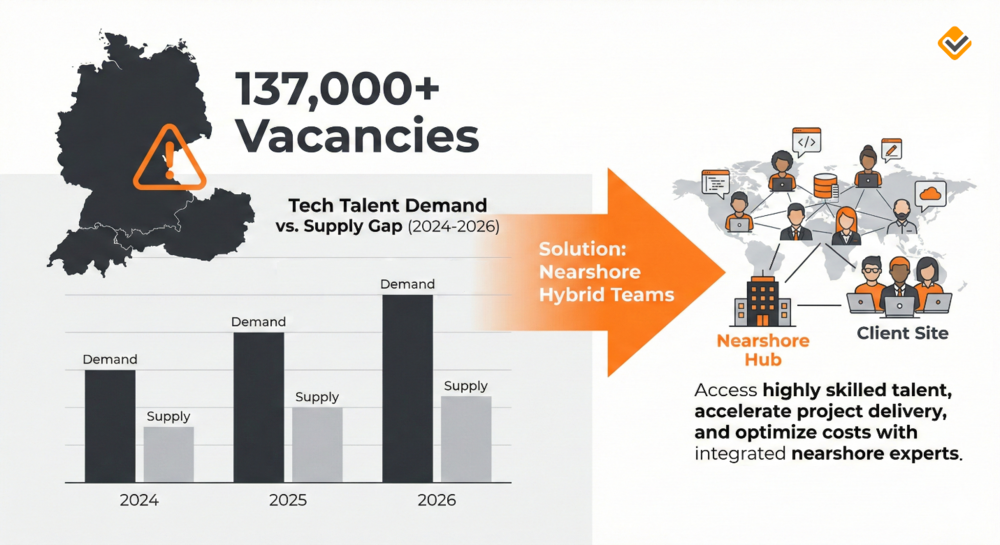
In 2026, the DACH developer shortage is no longer a cyclical hiccup but a long-term structural crisis. A 2022 Bitkom study found that Germany had a shortfall of 137,000 IT specialists across all sectors; only 8% of companies believed the supply of IT talent was sufficient while 74% reported a shortage. A follow-up survey in 2025 showed that the situation had not improved: around 109,000 IT positions remained unfilled and 85% of companies still complained of a shortage.
TL;DR: The DACH region faces a structural tech talent crisis with 109,000+ unfilled IT roles in Germany alone. Nearshore hybrid teams—combining onsite leadership with remote engineers from nearby countries—offer a strategic solution. This model cuts hiring time from months to weeks, reduces costs by 30-40% compared to local hires, and maintains EU regulatory compliance. Best for DACH companies needing AI, ML, data engineering, or DevOps specialists.
Understanding the DACH Tech Talent Gap
Quantifying the Gap
The scale of the tech talent gap in Germany is sobering. Bitkom's 2022 survey reported a deficit of 137,000 IT specialists, up from 124,000 before the pandemic. Despite macroeconomic slowdowns, the shortage intensified because digitalisation accelerated, and pandemic-related declines in hiring were temporary. By 2025 the shortfall still exceeded 109,000 unfilled roles. A mere 8% of companies felt that supply was adequate, while 79% expected conditions to worsen. In Switzerland, the high-cost hub of the region, over 135,000 technology roles remained open. These numbers illustrate a systemic imbalance between supply and demand.
Root Causes
Several factors contribute to the persistent gap. Demographics play a leading role: as the German population ages, there are fewer graduates in STEM fields and more retirements. University enrolment in computer science has fallen; only 72,075 first-semester students were recorded in 2021. Meanwhile, digital transformation and AI adoption spur demand for mid- and senior-level engineers.
Recruitment frictions exacerbate the gap. Time-to-hire remains long: an IT vacancy in Germany stays open for 7.1 months on average—up from 6.6 months a year earlier. In Switzerland the hiring cycle stretches toward three months. Employers often cannot meet salary expectations: 63% of German companies say applicants' salary demands exceed what firms can pay, and 44% cite unwillingness to relocate as a barrier.
Another cause is skill misalignment. Modern software and AI development increasingly require expertise in machine learning, data engineering, and cloud architecture. Many potential candidates lack these competencies. Companies frequently encounter candidates without the necessary soft skills or advanced technology knowledge. Some organisations attempt to fill gaps with career changers or internal upskilling programmes, but progress is slow.
Economic Impact
The talent shortage imposes quantifiable costs. StepStone's "cost of vacancy" analysis estimates that unfilled IT roles cost about €37,300 for companies with over 250 employees. These costs encompass lost revenue, delays, employee burnout, and missed opportunities. Additionally, long hiring cycles force companies to delay product launches and scale back digital initiatives. As Bitkom President Achim Berg observed, the shortage has become a key obstacle to Germany's digital transformation.
To maintain competitiveness, DACH businesses must rethink how they access talent. Hiring from global markets is one solution, but visa bottlenecks and cultural fit issues limit its effectiveness. Nearshore hybrid teams offer a balanced approach by tapping talent in neighbouring countries while preserving organisational culture and regulatory alignment.
What Are Nearshore Hybrid Teams?
Defining Nearshore and Hybrid Staff Augmentation
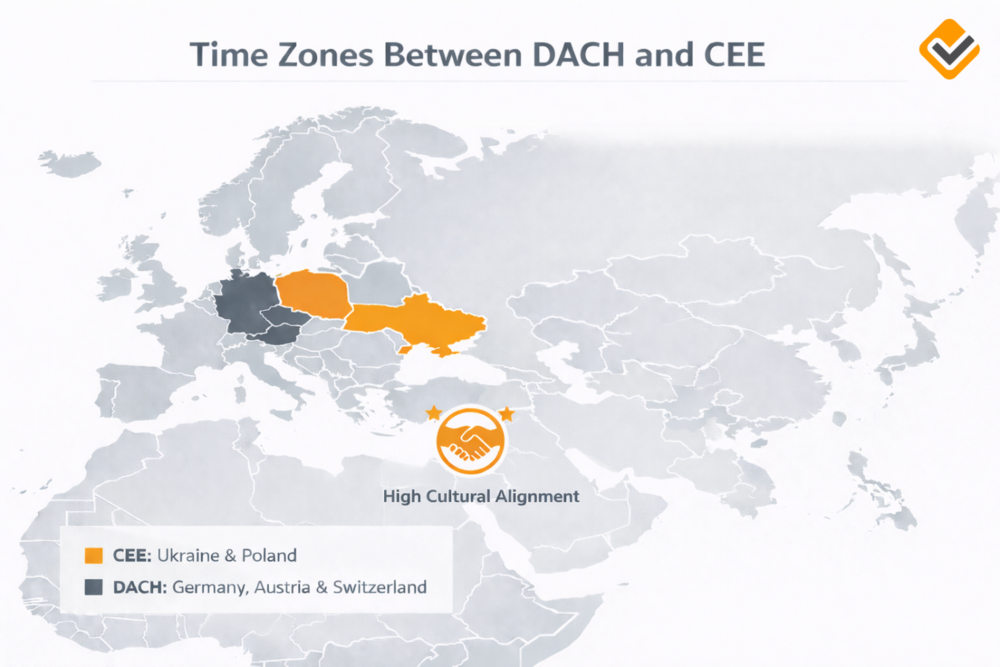
Nearshore describes hiring or partnering with remote teams in countries geographically close to the client, often within the same or adjacent time zones. For DACH companies, nearshore locations include Poland, Ukraine, Romania, or the Balkans. These regions offer abundant technical talent at competitive rates, strong education systems, and cultural similarities.
Hybrid staff augmentation blends nearshore remote engineers with an onsite core team. Rather than fully outsourcing a project, the client retains ownership, sets direction, and integrates external developers into internal workflows. This model differs from purely offshore outsourcing—which typically sends projects to distant time zones in Asia or Latin America—and from traditional staff augmentation, which focuses on contract workers integrated into a team on-site.
Differentiating from Offshore and Outsourcing
| Model | Location & Time Zone | Ownership & Control | Cost & Flexibility | Cultural Alignment |
|---|---|---|---|---|
| Local Hiring | Same country | Full control but limited scalability | Highest costs; long time-to-hire | High |
| Offshore Outsourcing | Distant regions (e.g., Asia) | Project ownership often transferred to vendor | Lower cost but potential quality and IP risks | Greater cultural & time-zone differences |
| Nearshore Hybrid Teams | Nearby countries (e.g., Poland, Ukraine) | Client retains strategic control, vendor provides talent | Cost-effective; faster scaling; TCO optimized | High cultural affinity; overlapping time zones |
This table illustrates that nearshore hybrid teams strike a balance between local hiring and offshore outsourcing. They reduce costs and accelerate time-to-hire while maintaining oversight.
Why Nearshore Works for DACH
Nearshore regions in Eastern Europe have become hubs for software development and AI. Many engineers there speak English or German and understand Western business practices. Geographic proximity allows travel for critical workshops, and shared cultural norms simplify communication. Importantly, nearshore countries comply with European Union regulations, including data privacy and labour laws, easing legal complexities. These factors make nearshore partnerships ideal for DACH companies seeking to scale quickly without losing control over quality or compliance.
Benefits of Nearshore Hybrid Teams for DACH Companies
Speed to Hire and Access to Scarce Skills
One of the most immediate benefits of nearshore hybrid models is speed. With local hiring taking 7-8 months on average, DACH companies struggle to meet aggressive deadlines. Nearshore partners maintain talent pools, allowing them to fill roles in weeks. They also provide access to specialists in emerging technologies like AI/ML, data engineering, and DevOps—skills that are in short supply locally. Organisations can ramp up or down quickly depending on project needs, reducing both opportunity costs and burnout on overstretched internal teams.
Cost Efficiency and Total Cost of Ownership (TCO)
Labour cost differentials make nearshore solutions attractive. Swiss IT salaries average CHF 106,000, and salary inflation continues at over 8% per year. German wages are slightly lower but still high relative to Eastern Europe. Nearshore hybrid teams reduce the total cost of ownership (TCO) by lowering direct labour expenses, mitigating recruitment costs, and minimising the cost of vacancy (up to €73,000 per unfilled role). Because the client retains strategic control, there are fewer hidden costs compared to outsourcing arrangements.
Maintaining Culture, Quality, and Control
A common fear about offshoring is losing visibility and diluting organisational culture. Hybrid models avoid this by keeping core product owners, architects, and team leads onsite. Remote engineering teams integrate through shared documentation, daily stand-ups, and collaborative tools. Similar time zones facilitate real-time communication. Cultural alignment is stronger than with distant offshore teams because Eastern European countries share work norms, communication styles, and often language proficiency.
Nearshore partners also adhere to European Union labour and data protection laws, including the GDPR and upcoming EU AI Act. This ensures that intellectual property and data remain secure and that AI initiatives comply with risk-classification, transparency, and human-in-the-loop requirements.
Comparative Checklist: Why Choose Nearshore Hybrid?
- Faster recruitment — Access to pre-vetted talent pools cuts hiring time from months to weeks
- Reduced costs — Lower salaries and overheads compared with local hiring, and lower risk premiums than offshoring
- Regulatory alignment — Compliance with EU data and labour laws
- Cultural proximity — Shared work culture and overlapping time zones facilitate seamless collaboration
- Scalability — Scale teams up or down quickly as project needs evolve
- Control — Client retains strategic oversight and decision-making authority
Collectively, these factors contribute to a higher return on investment (ROI) than either local hiring or offshore outsourcing.
Building and Managing Nearshore Hybrid Teams: Best Practices
Selecting the Right Partner
Choosing a nearshore vendor is a strategic decision. Look for partners with a strong track record in your industry, demonstrable expertise in your technology stack, and robust references. Evaluate their recruitment processes, retention strategies, and employee development programmes. Assess language proficiency, cultural compatibility, and alignment with EU regulations. A good partner should provide transparent pricing, flexible engagement models, and clear escalation paths. Interview their team leads to gauge communication and problem-solving skills.
Integration and Communication
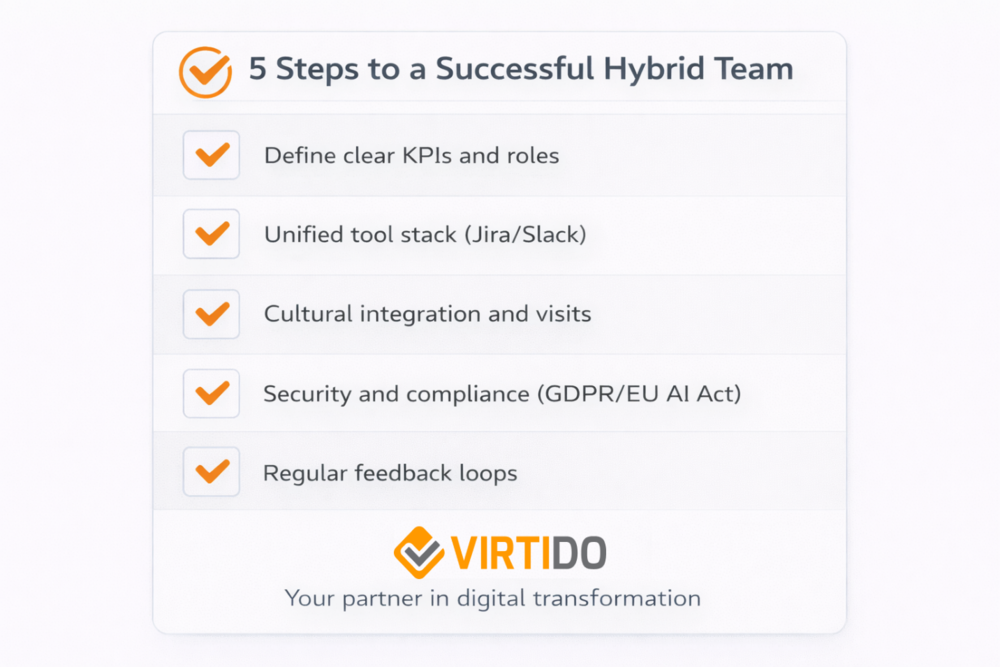
Successful hybrid teams function as one team, not as separate silos. Establish cross-functional squads comprising onsite and nearshore members. Use collaborative tools—such as JIRA, Confluence, Slack, and video conferencing—to share documentation, track progress, and foster open communication. Set up daily stand-ups, sprint planning sessions, and retrospectives that include everyone. Provide nearshore engineers with access to the same tooling and environments as onsite staff. If possible, host face-to-face workshops at project kickoff or major milestones to build rapport.
Agile and AI-Native Workflows
Adopting agile methodologies (Scrum or Kanban) enables rapid iteration and clear feedback loops. For AI projects, incorporate AI-native workflows that account for model training, evaluation, data pipelines, and human-in-the-loop validation. Nearshore teams should understand these pipelines and share ownership of datasets and model performance. Standardising processes ensures consistency across locations and reduces misalignment.
Legal and Compliance Considerations
Labour laws vary across countries, so ensure your contracts comply with local regulations (taxation, benefits, termination). Data protection is paramount when dealing with sensitive information or training AI models. Select partners that implement ISO 27001 or similar standards, maintain secure data centres, and restrict access based on roles. Verify that AI development follows EU AI Act guidelines, including risk classification, documentation, and human oversight. Engaging a nearshore partner with legal and compliance experience simplifies these complexities.
Overcoming Challenges and Mitigating Risks
Communication and Cultural Barriers
Differences in communication styles or work habits can create friction. To mitigate this:
- Provide cultural training — Both onsite and nearshore teams should understand norms, holidays, and communication preferences
- Establish clear documentation — Document workflows, coding standards, and decision-making processes
- Appoint bilingual team leads — Bridge linguistic gaps with leads who speak both languages
- Create shared rituals — Virtual coffee breaks and knowledge-sharing sessions build relationships
These practices foster trust and reduce misinterpretations. Remember that strong communication is equally important across local teams; hybrid models simply make these requirements explicit.
Security and Compliance
Working with remote engineering teams raises concerns about data protection and intellectual property. Choose partners with advanced security protocols—multi-factor authentication, network segmentation, encryption of data in transit and at rest. Align on IP ownership in contracts. Use zero-trust architectures to ensure that access privileges are based on least privilege and regularly audited.
Compliance with the GDPR and EU AI Act is non-negotiable. The upcoming AI Act requires high-risk AI systems to include robust human oversight and transparency measures. Nearshore partners must understand these obligations and implement audit trails, documentation, and human-in-the-loop controls. Conduct regular compliance assessments and update practices as regulations evolve.
Managing Distributed Teams
To maintain productivity, set clear performance metrics—timely delivery, code quality, innovation contributions—and review them regularly. Use objective measures to avoid bias against remote staff. Provide growth opportunities, training, and feedback for nearshore engineers. Encourage knowledge transfer to build redundancy and reduce single points of failure. Recognise remote team achievements publicly to foster inclusion and retention.
Finally, invest in leadership development for managers overseeing hybrid teams. Effective leaders must be adept at remote communication, conflict resolution, and cross-cultural empathy.
How Nearshore Hybrid Teams Could Work: Example Scenarios
To illustrate the potential of nearshore hybrid teams, consider these hypothetical scenarios based on common challenges DACH companies face.
Scenario 1: Accelerating a Software Development Initiative
Imagine a mid-sized German manufacturing firm planning to build an AI-enabled predictive maintenance platform. With local hiring timelines stretching to 7+ months, the project faces significant delays. By engaging a nearshore partner, the company could staff a hybrid team of data scientists, software engineers, and QA specialists within weeks rather than months. With onsite architects setting direction and nearshore developers executing, such a setup could potentially reduce time-to-hire by 50-60% and cut labour costs by 30% compared with local hiring alone—accelerating time-to-market considerably.
Scenario 2: Building AI and Machine Learning Capabilities
Consider a DACH fintech company looking to integrate generative AI into its customer onboarding process but lacking internal machine-learning expertise. A nearshore hybrid team specialising in LLM fine-tuning and Retrieval-Augmented Generation (RAG) could fill this gap. With remote engineers working alongside onsite compliance officers, such a team could help ensure adherence to the EU AI Act while bringing specialised skills that would be difficult to recruit locally. The hybrid model keeps sensitive data governance decisions in-house while leveraging external technical execution.
Scenario 3: Modernising Back-Office Operations
Picture an Austrian logistics company struggling with invoice processing backlogs, where processing time exceeds ten days and causes cash-flow issues. A nearshore team could help deploy a document intelligence solution using large language models, integrating it with existing ERP systems. By collaborating with onsite finance staff, such a setup could significantly reduce processing time and error rates, freeing the in-house team to focus on exception handling and customer relationships rather than routine processing.
These scenarios illustrate how nearshore hybrid teams can address common DACH business challenges. The key ingredients for success remain consistent: clear objectives, collaborative workflows, and mutual trust between onsite leadership and remote engineering teams.
How Virtido Can Help You Build Nearshore Hybrid Teams
At Virtido, we help DACH companies access vetted engineering talent from Central and Eastern Europe through our hybrid staff augmentation model—getting you qualified candidates in weeks, not months.
What We Offer
- Pre-vetted nearshore talent — AI/ML engineers, data scientists, software developers, and DevOps specialists from Poland, Ukraine, and other nearshore locations
- Fast time-to-start — 2-4 weeks from engagement to onboarded engineer, vs 7+ months for local DACH hiring
- 30-40% cost savings — Access senior talent at nearshore rates without compromising quality
- Swiss contracts — Full IP protection and clean legal framework under Swiss law
- Flexible engagement — Scale up or down as project needs change with no long-term lock-in
We've placed AI and software engineering talent across industries including financial services, healthcare, logistics, and enterprise software. Our engineers integrate seamlessly with your workflows, work in your time zone, and follow your processes.
Conclusion and Next Steps
The DACH developer shortage is a structural issue driven by demographics, long hiring cycles, and intense competition for advanced skills. Germany alone still has over 109,000 unfilled IT roles, and Switzerland faces more than 135,000 open technology positions. Salary inflation and protracted recruitment make local hiring increasingly unsustainable.
Nearshore hybrid teams offer a compelling alternative: they provide access to scarce talent at lower cost, accelerate time-to-hire, and maintain strategic control. Hybrid models also align with EU regulations and cultural expectations, making them well-suited for DACH companies.
To capitalise on this opportunity, CTOs and hiring managers should:
- Assess internal capability gaps — Identify critical skills lacking internally and prioritise projects where delays carry high opportunity costs
- Evaluate nearshore partners — Use the criteria outlined above (technical expertise, cultural fit, security practices) to select a vendor
- Pilot a hybrid team — Start with a focused project to refine collaboration, communication, and integration processes
- Scale responsibly — As the partnership matures, expand the hybrid model across more projects, continuously measuring performance and ROI
By adopting nearshore hybrid teams, DACH businesses can overcome the tech talent shortage and accelerate innovation without compromising quality or compliance.
Frequently Asked Questions
What is a nearshore hybrid team?
A nearshore hybrid team combines onsite employees with remote engineering teams located in nearby countries. The model leverages the cultural and time-zone alignment of nearshoring while keeping leadership and strategic control in-house. For DACH companies, this typically means partnering with engineers in Poland, Ukraine, Romania, or the Balkans.
Why is Germany facing a tech talent shortage?
Germany's shortage stems from demographic change, declining computer-science enrolment, long hiring cycles (average 7.1 months per vacancy), and growing demand for advanced skills in AI, data engineering, and cloud architecture. Only 8% of companies report adequate IT talent supply, and 79% expect conditions to worsen.
How many IT roles are unfilled in the DACH region?
Bitkom's 2022 study reported a deficit of 137,000 IT specialists in Germany. In 2025 there were still around 109,000 unfilled positions. Switzerland had more than 135,000 open technology roles. Combined, the DACH region has over 250,000 unfilled tech positions.
What are the cost savings of nearshore hybrid teams?
Nearshore teams reduce salary expenses compared with local hiring—Swiss IT salaries exceed CHF 106,000 annually, while Eastern European rates are significantly lower. They also reduce the cost of vacancy (unfilled roles cost up to €73,000) and avoid hidden costs associated with offshore outsourcing. Typical savings range from 30-40% compared to local DACH hires.
How do nearshore teams maintain quality and compliance?
Nearshore partners typically operate within the EU, adhering to GDPR and preparing for the EU AI Act. Clients retain code ownership and can enforce quality standards through agile processes, code reviews, and human-in-the-loop checks. The hybrid model ensures strategic decisions remain with onsite leadership while nearshore teams handle execution.
What challenges might arise with nearshore hybrid teams?
Potential challenges include communication gaps, cultural differences, and data security concerns. These can be mitigated through clear documentation, regular syncs, cultural training, and choosing partners with strong security certifications (ISO 27001, SOC 2). Bilingual team leads help bridge linguistic gaps.
Are nearshore hybrid teams suitable for AI and machine learning projects?
Yes. Nearshore regions produce many AI specialists, and hybrid models ensure that data governance and model decisions remain under the client's control. Projects involving Retrieval-Augmented Generation (RAG), LLM fine-tuning, and ML platforms benefit from nearshore expertise while maintaining EU AI Act compliance.
How do nearshore hybrid teams compare with offshore outsourcing?
Nearshore hybrid teams offer overlapping working hours, cultural proximity, and EU regulatory alignment, reducing communication delays and legal risks. Offshore outsourcing may offer lower hourly rates but often comes with greater time-zone differences, potential IP risks, and quality concerns. The nearshore hybrid model provides the best balance of cost, control, and quality.
What types of roles are best suited for nearshore hybrid models?
Roles requiring specialised expertise—such as AI/ML engineers, data scientists, DevOps specialists, and full-stack developers—are ideal. These skills are scarce in DACH markets but abundant in nearshore regions. Administrative or highly regulated roles may remain onsite, while technical execution can be distributed.
How quickly can nearshore teams be onboarded?
Nearshore partners with pre-vetted talent pools can typically place engineers within 2-4 weeks, compared to 7+ months for local DACH hiring. This speed advantage makes nearshore hybrid teams ideal for urgent projects, rapid scaling, or filling critical skill gaps quickly.