AI is no longer a research project or a competitive differentiator for early adopters. It's becoming infrastructure — the layer on which products, operations, and customer experiences are being rebuilt. According to McKinsey's 2024 State of AI report, 72% of organizations had adopted AI in at least one business function — up from 50% in the previous year. Companies that can't integrate AI into their core systems are finding themselves at an increasing disadvantage.
But building real AI capabilities is harder than the marketing suggests. It requires a specific combination of data engineering, machine learning expertise, software architecture, and product judgment that most companies don't have in-house. That's what AI software development services exist to provide.
TL;DR: AI software development services help companies design, build, and deploy custom AI systems — from machine learning models to agentic AI workflows. This guide covers service types, when to build vs buy, how to evaluate vendors, EU AI Act compliance, and realistic cost expectations. Nearshore teams can cut costs by 40–60% without sacrificing quality.
What Are AI Software Development Services?
AI software development services are professional services provided by technical firms or specialized engineers to design, build, integrate, and maintain AI-powered systems and applications.
This covers a wide range:
- Machine learning models — Building and integrating them into production systems
- Custom AI applications — Recommendation engines, prediction systems, classification tools
- LLM integration — Connecting large language models to products and internal workflows
- Agentic AI systems — Autonomous systems that execute multi-step tasks
- Computer vision and NLP — Image analysis, document processing, speech recognition
- AI data infrastructure — Pipelines, feature stores, and MLOps systems
The common thread: these are bespoke engineering services, not off-the-shelf software. The client gets a custom AI system or integration, not a license to a third-party tool.
The global AI software market was valued at $98.1 billion in 2024 and is projected to reach $391 billion by 2030, growing at a CAGR of 26%, according to Grand View Research. As that market expands, the demand for engineers who can actually build and deploy production-quality AI systems — not just run notebooks — continues to outpace supply.
Types of AI Software Development Services
Machine Learning Development
Building models that learn patterns from data and use those patterns to make predictions or decisions. Applications include fraud detection, demand forecasting, churn prediction, credit scoring, and dynamic pricing. ML development requires data engineers, ML engineers, and often domain experts who understand the business context behind the data.
Natural Language Processing (NLP)
Systems that process, understand, or generate human language. This includes document classification, sentiment analysis, named entity recognition, contract review tools, multilingual translation, and customer support automation. Modern NLP applications are largely built on top of LLM APIs rather than trained from scratch.
LLM Integration and Customization
Connecting existing large language models (GPT-4o, Claude, Gemini, open-source models like Llama or Mistral) to enterprise applications, internal knowledge bases, and business workflows. This includes retrieval-augmented generation (RAG) systems, fine-tuning, prompt engineering, and custom orchestration.
Related: What is RAG? Retrieval-Augmented Generation explained
Agentic AI Development
Building AI systems that don't just respond to queries — they plan, take actions, use tools, and work through multi-step tasks autonomously. Agentic AI systems can browse the web, write and execute code, interact with APIs, manage workflows, and operate other software on behalf of users or organizations.
Related: How AI agents work: building and implementing AI agents in modern enterprises
Computer Vision
Systems that interpret and analyze visual data — images, video, documents. Applications include quality control in manufacturing, medical image analysis, document processing, surveillance systems, and retail analytics.
AI-Powered Data Infrastructure
Building the data pipelines, feature stores, vector databases, and ML operations (MLOps) infrastructure that makes AI systems reliable and maintainable in production. AI models are only as good as the data and infrastructure behind them.
Related: Vector databases explained: how to choose the right one
AI Software Development Services at a Glance
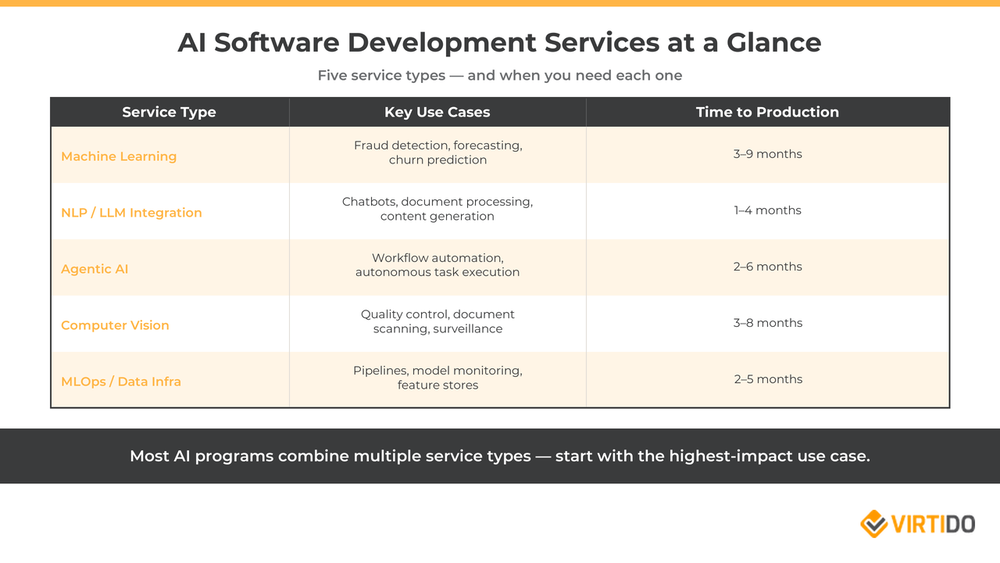
| Service Type | Primary Use Cases | Typical Skills Required | Time to Production |
|---|---|---|---|
| Machine Learning | Fraud detection, forecasting, churn prediction | ML engineer, data engineer, domain expert | 3–9 months |
| NLP / LLM Integration | Document processing, chatbots, content generation | LLM engineer, backend developer | 1–4 months |
| Agentic AI | Workflow automation, autonomous agents | AI architect, DevOps, ML engineer | 2–6 months |
| Computer Vision | Quality control, document scanning, surveillance | CV engineer, data labeling specialist | 3–8 months |
| MLOps / Data Infra | Pipelines, model monitoring, feature stores | Data engineer, DevOps, ML engineer | 2–5 months |
Custom AI vs Off-the-Shelf AI Tools
Before engaging an AI development firm, it's worth understanding when custom development is necessary versus when existing tools suffice.
Use existing AI tools when:
- Standardized tasks — Sentiment analysis, basic document classification, image tagging
- Commercial solutions work — OpenAI, Google Cloud AI, or Azure AI already solve the problem adequately
- Speed matters most — Deployment speed outweighs optimization
- No sensitive data — The use case doesn't involve proprietary or sensitive data
Use custom AI development when:
- Competitive differentiation — Your advantage depends on AI capabilities competitors can't replicate
- Proprietary data — Your data can't be sent to third-party APIs
- Deep integration — You need AI embedded in existing systems, not as a standalone tool
- Performance requirements — Latency or cost requirements exceed what commercial APIs deliver
- Regulatory control — GDPR, HIPAA, or EU AI Act require control over data processing and storage
Most companies end up with a hybrid: commercial AI APIs for commodity tasks, custom development for capabilities that drive differentiation.
Related: Enterprise AI implementation guide
How to Evaluate AI Development Vendors
AI development is a field where credential inflation is rampant. Every firm claims to "harness the power of AI." Here's how to cut through the noise:
Ask for Production References, Not Demos
A compelling demo proves almost nothing about the ability to deliver maintainable, scalable systems that work in production. Ask for references from clients whose AI systems have been running in production for at least 6–12 months.
Assess the Full-Stack Capability
AI development requires multiple engineering disciplines that don't always co-exist in the same team: data engineering, ML engineering, backend development, DevOps/MLOps, and product engineering. A firm that is strong in ML modeling but weak in production engineering will deliver models that work in notebooks but fail in production.
Evaluate Their Data Practices
AI systems are only as good as their training data and data pipelines. Ask how the firm approaches data quality, data governance, and feature engineering. Weak data practices create AI systems that degrade unpredictably over time.
Ask About MLOps and Ongoing Maintenance
Shipping an AI model is not the end of the engagement — it's the beginning. Models drift as the world changes. Ask how the firm handles model monitoring, retraining, versioning, and incident response in production.
Understand Their LLM Approach
In 2025–2026, most AI development projects involve LLMs in some way. Ask whether the firm has a clear opinion on model selection (open-source vs. commercial), fine-tuning vs. prompt engineering, RAG architecture, and cost optimization.
Evaluate EU AI Act Readiness
The EU AI Act is in force. AI systems deployed in European markets must meet increasingly specific requirements depending on their risk classification. A partner working with European clients should understand compliance requirements, model documentation standards, and risk assessment frameworks.
Related: AI governance and EU AI Act compliance guide
Vendor Evaluation Scorecard
Use this checklist when evaluating AI development proposals:
| Evaluation Criterion | What to Ask | Red Flags |
|---|---|---|
| Production experience | Show me 3 AI systems currently running in production | Only demos available; no post-launch references |
| Team composition | Who covers data engineering, ML, and backend? | Single generalist "AI developer" for all roles |
| Data practices | How do you handle data quality and GDPR compliance? | Vague answers; no mention of data governance |
| MLOps capabilities | How do you handle model drift and retraining? | No monitoring plan after delivery |
| LLM strategy | Open-source vs. commercial? Fine-tuning vs. RAG? | No opinion; will "use whatever you want" |
| EU AI Act knowledge | Which risk category does our use case fall into? | Unfamiliar with the framework |
| Cost transparency | Fixed price or T&M? What drives scope changes? | No milestone-based delivery plan |
AI Software Development in Europe: Regulatory and Compliance Context
European companies building AI systems operate in a more complex regulatory environment than their US counterparts. The EU AI Act, which entered application phases from 2024 onward, introduces a risk-based classification framework:
| Risk Category | Examples | Compliance Requirements |
|---|---|---|
| Unacceptable (Prohibited) | Social scoring, real-time biometric ID in public spaces | Prohibited — cannot be deployed |
| High-risk | AI in hiring, credit scoring, healthcare, education | Conformity assessment, transparency docs, human oversight, incident reporting |
| Limited risk | Chatbots, deepfakes, emotion recognition | Transparency obligation: users must know they interact with AI |
| Minimal risk | Spam filters, recommendation systems, AI productivity tools | No mandatory requirements under the Act |
For most enterprise AI applications — internal workflow automation, customer support agents, data analysis tools — the EU AI Act burden is limited. But for companies in financial services, healthcare, or HR automation, high-risk classification may apply.
GDPR and AI Data Processing
GDPR compliance in AI development is more complex than in conventional software:
- Training data — Using personal data to train ML models requires a lawful basis under GDPR
- Automated decision-making — When AI systems make decisions about individuals, GDPR's Article 22 provisions may apply
- Data minimization — AI models should be trained on the minimum personal data necessary
- Cross-border data flows — Training AI on European data using non-EEA infrastructure requires appropriate transfer mechanisms (SCCs, adequacy decisions)
An AI development partner working with European clients should build data governance into the project from the start — not add it as an afterthought.
AI in Swiss Financial Services
Switzerland's financial services sector is among the most AI-active in Europe. Common applications include credit risk modeling, AML transaction monitoring, fraud detection, KYC document processing, and customer service automation.
FINMA requires that financial institutions maintain control over AI systems used in critical processes — including the ability to explain decisions, audit model behavior, and intervene when systems fail. This makes model interpretability, logging, and human oversight not just best practices but regulatory requirements.
Cost and Timeline Expectations
AI development costs vary significantly based on project complexity:
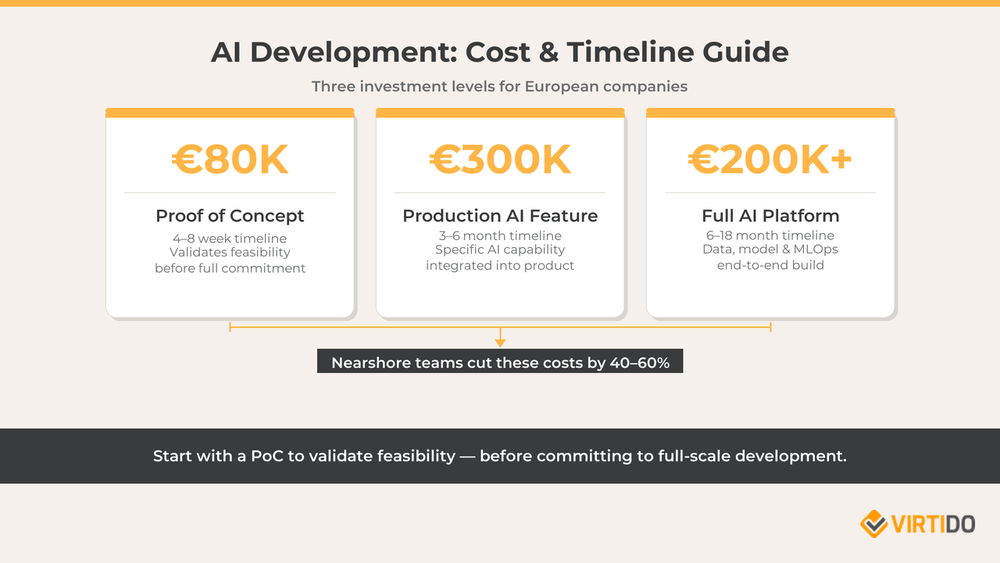
| Project Type | Typical Duration | Indicative Cost Range | Scope |
|---|---|---|---|
| Prototype / Proof-of-Concept | 4–8 weeks | €25,000 – €80,000 | Validates feasibility before production commitment |
| Production AI Feature | 3–6 months | €80,000 – €300,000 | Specific AI capability integrated into existing product |
| Full AI Platform / Agentic System | 6–18 months | €200,000+ | End-to-end: data infra, model dev, deployment, MLOps |
Companies working with nearshore AI development teams — particularly those with European delivery centers and Swiss or Western European management — typically see 40–60% cost savings versus equivalent local teams, without significant quality trade-offs for well-chosen partners.
Related: Nearshore vs offshore development: a practical guide
How Virtido Can Help You Build AI Systems
At Virtido, we provide AI consulting, rapid prototyping, and full agentic AI development — helping companies move from AI strategy to working production systems quickly.
What We Offer
- AI Rapid Prototyping — Working AI proof-of-concept in 4–6 weeks, validating the approach before committing to full-scale development
- Agentic AI Development — Autonomous AI agents for customer support, content workflows, data processing, and task automation
- LLM Integration — RAG systems, fine-tuning, and custom orchestration connected to your enterprise applications
- AI Consulting for Leaders — Strategic workshops and AI strategy development for executive teams
- Nearshore AI Teams — Pre-vetted AI/ML engineers from Poland and Ukraine at 40–60% lower cost than local hires
We've delivered AI solutions for clients across financial services, professional services, healthcare, and technology. Our approach starts with understanding the business problem, not the technology — ensuring you build AI that drives real value.
Conclusion and Next Steps
AI software development services bridge the gap between AI ambition and AI reality. Most companies don't have — and shouldn't try to build — all the specialized capabilities needed for production AI in-house. The right partner brings data engineering, ML expertise, production engineering, and domain knowledge together in a way that's hard to assemble organically.
The key decisions are:
- Build vs buy — Use commercial AI APIs for commodity tasks, custom development for differentiation
- Partner selection — Prioritize production references, full-stack capability, and EU AI Act readiness
- Start small — Validate with a prototype before committing to full-scale development
- Plan for maintenance — AI systems require ongoing MLOps, not just initial deployment
For European companies, working with a partner that understands EU AI Act compliance and GDPR requirements from day one avoids expensive retrofits later. And for companies watching costs, nearshore teams with European delivery centers offer a compelling balance of quality and economics.
Frequently Asked Questions
What's the difference between AI development services and AI consulting?
AI consulting focuses on strategy: assessing AI opportunities, building roadmaps, evaluating vendors and build-vs-buy decisions, and advising leadership. AI development services are the engineering work that executes on that strategy — building, integrating, and maintaining the actual AI systems. Many engagements start with consulting to define the approach and then move into development.
Do we need to have data before starting an AI development engagement?
Not necessarily, but data availability significantly affects scope and timeline. A good AI development partner will assess your data situation early and help you understand what data collection or preparation is required before model development can begin.
How do we maintain AI systems after they're built?
AI systems require ongoing monitoring and maintenance — more so than conventional software, because model performance degrades as the data distribution shifts over time. Your partner should provide a clear MLOps plan: monitoring dashboards, alerting on performance degradation, retraining schedules, and versioning.
What is an agentic AI system, and do we need one?
An agentic AI system can plan and execute multi-step tasks autonomously, using tools (APIs, code execution, web browsing) to complete goals. They're appropriate when the task is complex enough that a simple prompt-response interaction is insufficient. Not every business problem needs an agentic solution — often a well-designed LLM integration with good retrieval is sufficient.
How do we evaluate AI project proposals?
Compare vendors on: technical references in production, team composition (data engineers, ML engineers, backend engineers), approach to data and MLOps, clarity on timeline and milestones, and EU AI Act compliance practices. Be skeptical of firms that propose solutions before deeply understanding your data and business context.
Does our AI system need to comply with the EU AI Act?
It depends on where the system is deployed and what decisions it makes. If your AI system is used to make or assist decisions about individuals in high-risk categories (employment, credit, healthcare, essential services), EU AI Act compliance obligations apply. For most internal automation tools, workflow agents, or recommendation systems that don't directly affect individual rights, the compliance burden is much lower. The safest approach is to have your development partner conduct an EU AI Act risk assessment early in the project.
How do nearshore AI development teams compare to local vendors in Switzerland?
Nearshore teams — particularly those based in Central and Eastern Europe, operating under Swiss management — offer comparable technical quality at 40–60% lower cost. The key advantages: time zone alignment (1–2 hour difference), European data residency compliance, and cultural compatibility that enables close collaboration over multi-month programs.
How long does it take to build a production AI system?
A proof-of-concept typically takes 4–8 weeks. A production AI feature integrated into an existing product takes 3–6 months. Full AI platforms or complex agentic systems can take 6–18 months. Start with a prototype to validate feasibility before committing to full-scale development.