![Managed Services vs Staff Augmentation [2026 Guide]](https://virtido.com/hubfs/Virtido%20Guide.jpg)
A proper IT staffing strategy can make a big difference for your software development projects. As a business owner, CEO, CFO, or CTO, you should consider the differences between managed services vs staff augmentation in IT. While both are forms of outsourcing, they work quite differently.
If you choose a managed services model, the providers become your partners. They fully manage the IT tasks and development roadmaps you have agreed to. With staff augmentation, on the other hand, you invite qualified experts to join your existing teams and have them work directly under your control.
Learn about these two approaches to make the best choice for your needs.
TL;DR: Managed IT services fully outsource IT operations to a provider who manages everything per agreed SLAs. Staff augmentation adds skilled professionals to your existing team while you keep control. Choose managed services for hands-off IT operations; choose staff augmentation when you need specialized skills but want direct oversight of projects.
Why Do Businesses Need Managed IT Services?
Many businesses need help to operate efficiently, remain competitive, and deliver customer value through technology in their market. It may be challenging to find professionals or concentrate on business goals while managing IT infrastructure, developing roadmaps, and ensuring reliability, as engineering initiatives can become complex, resource-intensive, and costly. It's worth considering managed services to reduce internal overhead, offering the expertise, tools, and support needed to thrive.
While managed services come in various forms, the core concept remains the same: shifting the responsibility of IT maintenance and development from your company's internal teams to a service provider. In a well-structured managed services offering, you as a client gain the advantage of predictable costs and service level agreement, and can concentrate on your core business priorities while leaving IT management tasks to the experts.
Types of Managed IT Services
| Managed IT Strategy and Consulting Services | Companies choose these services to help their businesses align their technology goals and strategic initiatives with overall business objectives. Your MSP (Managed Services Provider) can offer IT roadmapping, strategic planning, legacy system assessments, and expert advice on choosing digital transformation solutions for growth in the market and changing approaches to commercial success. |
| Remote Monitoring Services | The team you hire monitors your company's IT infrastructure and applications to provide seamless performance and detect issues before they harm your business operations. These efforts include monitoring servers, networks, and applications to observe performance metrics and detect security breaches or operational anomalies. The MSP reports regularly, keeps systems running, minimizes downtime, and addresses issues so your IT infrastructure runs smoothly and efficiently. |
| Managed Application Support | From Level 1 (L1) through L2 and L3, your MSP will step in to interact with your internal users and customers who interact with your systems and applications to triage, troubleshoot, and solve ongoing issues in your application portfolio. Such support services can integrate seamlessly with your internal engineering department to take over at any level. |
| Managed Security Services | Security services include protective actions to keep digital assets safe. These services include firewall management, intrusion detection, anti-virus and anti-malware solutions, patching, infrastructure monitoring, and security system audits. |
| Managed Cloud Services | These services involve administering and optimizing public, private, or hybrid cloud infrastructures. MSPs help businesses with cloud strategy, migration, configuration, and management, ensuring your team uses cloud resources efficiently and securely. MSPs offer expertise in infrastructure as a service (IaaS), managing public cloud solutions in collaboration with major cloud providers such as Amazon Web Services (AWS), Google Cloud, and Microsoft Azure. They may also manage platform-as-a-service (PaaS) solutions or software-as-a-service (SaaS) as well as customer relationship management (CRM). |
| Managed Communication Services with AI Assistants | AI assistants are transforming business strategies to interact with clients, teams, and stakeholders. They help enhance customer engagement and automate the communication process with clients, offering smart calls, chatbots for 24/7 inquiries, personalized customer support, meeting organization, cross-platform communication integration, and built-in analytics for communication efficiency. |
| Project-based Managed Development Services | Outsourcing various IT projects to a service provider helps businesses manage their digital project's planning, implementation, and marketing efforts. These services are ideal for companies that need expert support for a one-project or short-term basis, such as custom software development, digital transformation of legacy systems, cloud migration, or cybersecurity tasks. |
| Telecommunication Services | Managed IT service providers are finding ways to differentiate themselves in the telecommunication sector. Some providers offer managed IP telephony services, taking full responsibility for managing and maintaining voice communication systems within a client's business environment. |
Managed Services Market Revenue
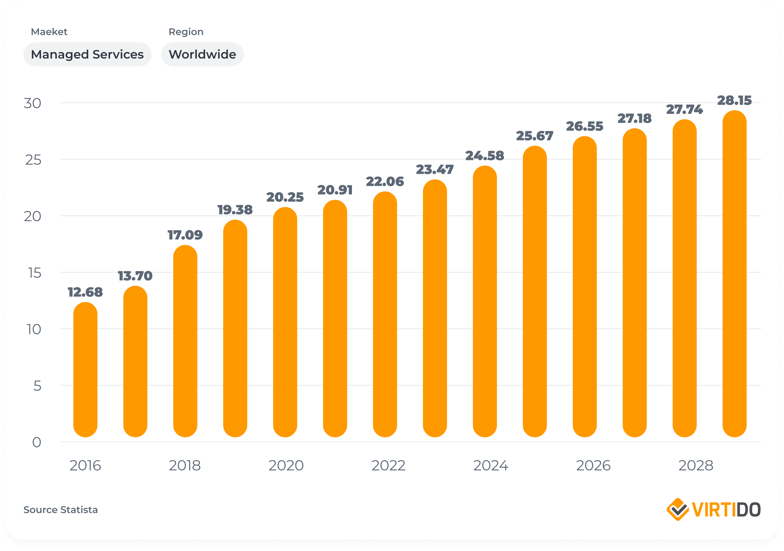
According to Statista, the managed services market revenue is expected to show an annual growth rate (CAGR 2024-2029) of 2.67%, resulting in a market volume of US$28.15bn by 2029.
What is Staff Augmentation?
Staff augmentation is a flexible outsourcing strategy where a company temporarily hires an external software development team or efficient talent to fill specific skill gaps or increase project potential. A strong staff augmentation partner typically handles hiring, payroll, and administrative tasks, allowing your business to focus on core operations.
The staffed experts offered by a provider become an extension of the company's internal IT team, following their rules, workflows, processes, and management. Key options your business gets with this model of cooperation:
- Temporary staffing solution — suitable for short-term projects or to address resource gaps
- Direct oversight — you supervise the augmented staff, process, and day-to-day tasks
- Cost-effective — avoids the overhead of full-time employment while providing access to specialized skills
Types of Staff Augmentation Services
| Short-Term Augmentation | Temporary staffing for periods under six months, like for a busy season, is often to cover employee absences, handle short-term projects, or manage workload spikes. |
| Long-Term Staff Augmentation | You invite external professionals to integrate into the team for six months or longer. This model suits businesses requiring ongoing support for specialized roles. |
| Dedicated Engineering Teams | Your staff augmentation partner supports you in building up a complete engineering team remotely that is hired and locally taken care of by the partner who seamlessly extends your engineering organization. |
| On-Demand Staff Augmentation | Quickly scaling the workforce to meet immediate needs, often for industries with unpredictable or seasonal demand. |
| Skill-Specific Staff Augmentation | Adding professionals with highly specialized expertise not available in-house, often for emerging or niche technologies: AI, ML, IoT, etc. |
| Project-Based Staff Augmentation | External professionals are hired for a specific project, such as digital transformation or cloud migration, and collaborate closely with the in-house development team. |
IT Staff Augmentation Market Size
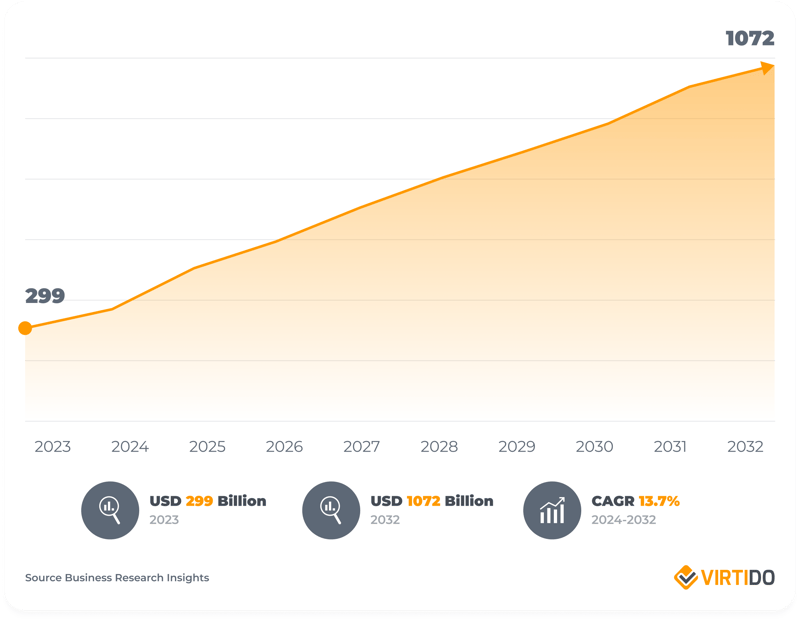
According to Business Research Insights, the IT Staff Augmentation and Managed Services Market size was valued at approximately USD 299 billion in 2023 and is expected to reach USD 1072 billion by 2032, growing at a compound annual growth rate (CAGR) of about 13.7%.
Top Industries Using IT Staff Augmentation
IT staff augmentation services are popular, especially across industries that rely on technology to change legacy systems and start the digital transformation, implement innovative technologies like AI or ML to increase customer engagement or analyze vast amounts of data to make decision-making processes more accurate.
Software Development
Software development vendors find clients who require specific expertise for tech projects, engaging staff augmentation talent to address skill gaps, manage fluctuating workloads, and speed up product development. Suppose a company requires skills on a short-term basis with emerging technologies like AI, blockchain, and cybersecurity. Staff augmentation can bridge skill gaps for a project that requires these skills.
Financial Services
Banks, fintech companies, and insurance companies require IT staff augmentation to maintain and enhance secure, reliable cloud systems. Skilled tech experts are critical for handling digital transactions, fraud detection, and regulatory compliance. Financial businesses usually require data analysts, cybersecurity specialists, compliance experts, and blockchain developers.
Healthcare
The modern healthcare industry increasingly relies on innovative IT solutions for electronic health records (EHR), telemedicine, and data analytics. Engaging staff augmentation talent helps develop patient-centered technologies and modernize existing systems. IT professionals found for staff augmentation can develop and maintain telemedicine platforms, patient portals, and mobile health apps, enhancing the patient experience and accessibility to care.
E-Commerce and Retail
With the boom in online shopping, e-commerce companies depend on IT staff augmentation models to develop platforms, integrate payment systems, develop AI assistants or chatbots to interact with their clients 24/7, and analyze user experiences using data analytics dashboards.
Logistics
The logistics industry uses advanced technological solutions to automate workflows, optimize supply chains, improve inventory management efficiency, and communication for brokers by automatically validating carriers, negotiate competitive rates, and save time. Logistics companies also search for solutions to enhance transportation management systems that optimize route planning, shipment tracking, and resource allocation.
Education
Due to the demand for online education, many educational institutions have stopped relying on outdated systems. EdTech platforms incorporate emerging technologies such as artificial intelligence, machine learning, augmented reality, and virtual reality. Skilled professionals provide access to adaptive learning algorithms, gamified content development, mobile learning apps, and learning management systems (LMS) enhancement.
Key Differences: Staff Augmentation vs Managed IT Services
Both staff augmentation and managed services provide businesses with access to external IT expertise, but they differ significantly in their approach, core business operations, scope, and responsibilities. Understanding these differences can help your company choose the right solution based on its needs and goals.
The comparison table below highlights the core distinctions across control, scope, pricing, and integration:
| IT Managed Services | Staff Augmentation Services |
|---|---|
| The outsourcing team entrusts IT operations or specific functions to a third-party service provider. | Staffing providers help add specialized talent to existing staff and address resource shortages. |
| The service provider is responsible for managing and delivering the agreed IT services according to SLAs. | The client retains control over the augmented staff's project management and task delegation. |
| Long-term focus on managing IT infrastructure, digital platforms, cybersecurity, cloud, delivery, etc. | Rather, project-based support is often focused on a particular skillset or role. |
| It is ideal for businesses that want to offload responsibility and manage IT complex projects entirely or partially to independent providers. | Offers flexibility to scale the IT workforce up or down based on the in-house staff's project demands or core competencies. |
| Offers packages with different levels of support: basic, intermediate, and advanced packages offer different service levels. | Paid on an hourly, monthly, or project-based basis for external talent or dedicated teams. |
| Focused on long-term partnerships for continuous IT support and improvements. | Typically short-term or project-based, although some augmented teams get longer durations. |
| Operates independently with minimal disruption to the client's internal operations. | Fully integrated into the client's team, requiring collaboration with in-house staff. |
Decision Framework: Which Model Fits Your Needs?
Choosing between managed services and staff augmentation depends on your organization's specific situation. Use this decision framework to evaluate which approach—or combination of approaches—makes sense for your business.
Questions to Ask Before Deciding
| Question | If Yes → Consider |
|---|---|
| Do you have strong internal project management and technical leadership? | Staff Augmentation — You can effectively direct external talent |
| Do you need 24/7 monitoring, support, or guaranteed uptime SLAs? | Managed Services — Providers specialize in continuous operations |
| Is the need temporary or project-specific (under 12 months)? | Staff Augmentation — More flexible for defined engagements |
| Do you want to focus entirely on core business without IT distractions? | Managed Services — Offload responsibility completely |
| Do you need specific technical skills (AI, blockchain, cloud migration)? | Staff Augmentation — Access specialized expertise on demand |
| Is predictable monthly IT spend a priority for budgeting? | Managed Services — Fixed pricing packages simplify planning |
| Do you need to scale the team up or down quickly based on project phases? | Staff Augmentation — Add or remove resources as needed |
| Do you lack internal IT infrastructure management expertise? | Managed Services — Provider brings operational expertise |
Decision Matrix by Company Profile
| Company Profile | Recommended Approach | Rationale |
|---|---|---|
| Startup with strong tech founders | Staff Augmentation | Leadership can direct external talent; need flexibility to pivot quickly |
| SMB without dedicated IT team | Managed Services | Need comprehensive IT support without building internal capacity |
| Enterprise with complex legacy systems | Hybrid (both) | Managed services for operations; staff augmentation for modernization projects |
| Fast-growing company scaling engineering | Staff Augmentation | Need to add developers quickly while maintaining direct control |
| Regulated industry (finance, healthcare) | Managed Services or Hybrid | SLAs and compliance documentation; specialized security monitoring |
| Agency or consultancy with variable workload | Staff Augmentation | Scale team based on client project demands |
Real-World Scenarios: When Each Model Shines
Abstract comparisons only go so far. Here are practical scenarios that illustrate when managed services, staff augmentation, or a hybrid approach delivers the best results.
Scenario 1: SaaS Startup Scaling Product Development
Situation: A Series A SaaS company with 15 employees needs to accelerate feature development. The CTO is hands-on and wants direct control over the engineering roadmap. They need three senior React developers and a DevOps engineer for 8-12 months.
Best fit: Staff Augmentation
- CTO maintains full control over priorities, code reviews, and architecture decisions
- Team scales quickly without lengthy hiring processes
- Flexibility to extend or reduce engagement based on funding milestones
- External developers integrate into existing Agile workflows and tools
Scenario 2: Manufacturing Company Modernizing IT Infrastructure
Situation: A mid-size manufacturing firm with 500 employees has outdated IT infrastructure. They lack internal IT expertise beyond basic helpdesk support. They need 24/7 network monitoring, security management, cloud migration, and ongoing maintenance.
Best fit: Managed Services
- Provider takes full responsibility for infrastructure reliability and security
- Predictable monthly costs with clear SLAs for response times and uptime
- No need to hire and manage specialized IT staff internally
- Focus remains on manufacturing operations, not IT management
Scenario 3: Financial Services Firm with Multiple Needs
Situation: A FinTech company with 200 employees needs continuous security monitoring and compliance (SOC 2, PCI-DSS) for their production systems. Simultaneously, they're building a new AI-powered fraud detection feature requiring specialized ML engineers for 6 months.
Best fit: Hybrid Approach
- Managed services for ongoing security operations, compliance monitoring, and infrastructure
- Staff augmentation for the ML engineering project—specialized skills under internal product leadership
- Clear boundaries: operations handled by MSP; innovation projects controlled internally
Scenario 4: E-commerce Company During Peak Season
Situation: An online retailer experiences 4x traffic during holiday seasons. They need additional QA engineers and support staff for 3 months annually, but year-round headcount doesn't justify permanent hires.
Best fit: Short-Term Staff Augmentation
- Bring in additional QA and support capacity only when needed
- Existing team leads manage the augmented staff directly
- No long-term commitments or overhead during slower months
- Same augmented professionals can return each season, reducing ramp-up time
The Hybrid Approach: Combining Both Models
Many organizations achieve optimal results by strategically combining managed services and staff augmentation. This hybrid approach isn't about choosing one over the other—it's about matching the right model to each business need.
How the Hybrid Model Works
| Function | Model | Why |
|---|---|---|
| IT infrastructure (servers, networks, cloud) | Managed Services | Requires 24/7 monitoring; benefits from provider expertise and SLAs |
| Security operations and compliance | Managed Services | Specialized, continuous monitoring with documented procedures |
| Product development and engineering | Staff Augmentation | Core differentiator; needs direct control and flexibility |
| Digital transformation projects | Staff Augmentation | Defined timelines; specialized skills; internal strategy ownership |
| Helpdesk and user support | Managed Services | Volume-based; benefits from established processes and tooling |
| AI/ML development initiatives | Staff Augmentation | Emerging skills; experimental projects; direct R&D oversight |
Benefits of the Hybrid Approach
- Optimized costs — Pay for managed services where scale and continuity matter; use augmentation where flexibility is key
- Risk distribution — Critical operations protected by SLAs; innovation projects remain agile
- Best-fit talent — Operations experts for infrastructure; specialized developers for product work
- Clear accountability — Each provider responsible for their domain with defined boundaries
Cost Comparison: Understanding the Financial Impact
Pricing structures differ significantly between the two models. Understanding these differences helps you budget accurately and evaluate total cost of ownership.
| Cost Factor | Managed Services | Staff Augmentation |
|---|---|---|
| Pricing model | Fixed monthly fee (tiered packages) | Hourly, daily, or monthly per resource |
| Predictability | High — budget set in advance | Variable — depends on team size and duration |
| Hidden costs | Change requests outside SLA scope | Management overhead; knowledge transfer |
| Scaling costs | Package upgrades (step changes) | Linear — add/remove individual resources |
| Typical savings vs in-house | 20-40% on IT operations | 30-50% on engineering (nearshore rates) |
| Minimum commitment | Often 12-24 months | Typically 1-3 months or project-based |
Total Cost of Ownership Considerations
When comparing costs, look beyond hourly rates or monthly fees:
- Recruitment savings — Both models eliminate internal hiring costs (typically 15-25% of annual salary per hire)
- Training and onboarding — Managed services include expertise; augmented staff need some ramp-up time
- Infrastructure — Managed services often include tooling; augmented staff use your existing systems
- Management overhead — Staff augmentation requires internal project management capacity
- Opportunity cost — What could your team accomplish if freed from IT operations?
Key Takeaways
Making the right choice between managed services and staff augmentation can significantly impact your operational efficiency, costs, and competitive position.
| Key Takeaway | Details |
|---|---|
| Control is the core difference | Managed services = hands-off with provider ownership. Staff augmentation = you retain direct control over people and projects. |
| Match model to need | Use managed services for ongoing operations and infrastructure. Use staff augmentation for projects, specialized skills, and flexible scaling. |
| Hybrid often wins | Many organizations combine both: managed services for IT ops, staff augmentation for development. Clear boundaries prevent overlap. |
| Consider your internal capacity | Staff augmentation requires project management capability. Managed services suit organizations without IT leadership. |
| Evaluate total cost | Look beyond rates to recruitment savings, management overhead, and opportunity costs. Both models typically save 20-50% vs full in-house teams. |
How Virtido Can Help You Choose the Right Model
At Virtido, we offer both staff augmentation and managed services — helping you choose the right model based on your control needs, project complexity, and internal capacity.
What We Offer
- Staff augmentation — Add individual experts to your team for any stage of your development cycle
- Dedicated teams — Full squads working exclusively on your projects under your direction
- Managed delivery — End-to-end project ownership with senior leadership as your single point of contact
- Flexible terms — Short-term sprints, long-term embedded teams, or full project outsourcing
- Swiss governance — Single contract under Swiss law with compliance handled across all locations
We've completed 500+ successful placements across FinTech, healthcare, e-commerce, and SaaS companies over 9+ years. Whether you need extra hands or a fully managed solution, we match the model to your needs.
Final Insights on Managed Services vs Staff Augmentation
The IT Staff Augmentation and Managed Services market continues to expand globally, with North America leading due to advanced infrastructure, major IT service providers, and a large pool of skilled professionals. As businesses pursue digital transformation, demand for both outsourcing models keeps growing.
Neither model is universally better—the right choice depends on your specific situation. Organizations with strong technical leadership often thrive with staff augmentation's flexibility and control. Those seeking to offload IT operations entirely benefit from managed services' comprehensive approach and predictable costs.
Increasingly, the most successful organizations don't choose between the two—they combine them strategically. By matching each model to the right business function, you can optimize costs, reduce risk, and maintain the agility needed to compete in a fast-changing market.
Frequently Asked Questions
What is the main difference between managed services and staff augmentation?
The key difference is control and responsibility. With managed services, you outsource entire IT functions to a provider who handles everything according to agreed SLAs. With staff augmentation, you hire external talent that integrates into your existing team while you retain full control over project management, tasks, and direction.
Which is more cost-effective: managed services or staff augmentation?
It depends on your needs. Managed services typically offer predictable monthly costs with comprehensive support packages, making budgeting easier. Staff augmentation is often more cost-effective for specific projects or skill gaps since you only pay for the talent you need, when you need it. Long-term engagements may favor managed services; short-term needs usually favor augmentation.
When should I choose managed IT services over staff augmentation?
Choose managed IT services when you want to offload IT responsibilities entirely, need 24/7 support and monitoring, prefer predictable costs through SLAs, lack internal IT management expertise, or want to focus entirely on core business activities without IT distractions.
When is staff augmentation the better choice?
Staff augmentation works best when you need specific technical skills for a defined project, want to maintain direct control over your development process, need to scale your team quickly, have strong internal project management capabilities, or require flexibility to adjust team size based on project phases.
Can I use both managed services and staff augmentation together?
Yes, many organizations successfully combine both approaches. A common strategy is using managed services for ongoing IT operations like infrastructure monitoring and security, while leveraging staff augmentation for specific development projects or when specialized skills are needed temporarily.
How quickly can I get started with staff augmentation versus managed services?
Staff augmentation typically offers faster onboarding, often within one to two weeks, since you're adding individuals to an existing structure. Managed services require more setup time for SLA negotiations, system integration, and knowledge transfer, typically taking four to eight weeks to fully implement.
What are the risks of managed services compared to staff augmentation?
Managed services risks include vendor lock-in, less control over day-to-day operations, and dependency on provider quality. Staff augmentation risks include management overhead, potential knowledge loss when contracts end, and the need for strong internal project leadership to direct the augmented team effectively.
How do pricing models differ between managed services and staff augmentation?
Managed services typically use fixed monthly fees based on service level packages (basic, intermediate, advanced), providing predictable costs. Staff augmentation usually charges hourly, daily, or monthly rates per resource, with costs varying based on skill level, technology expertise, and engagement duration.
Which model provides better scalability for growing businesses?
Both models offer scalability, but in different ways. Staff augmentation provides more agile scaling since you can add or remove individual team members as project needs change. Managed services scale by upgrading service packages, which may include minimum commitments but often offer better pricing at higher tiers.
What industries benefit most from managed services versus staff augmentation?
Managed services are popular in industries requiring continuous IT operations like healthcare, finance, and retail. Staff augmentation is preferred in software development, technology startups, and project-driven industries where specific technical skills are needed for defined periods. Many companies in FinTech and enterprise software use both approaches strategically.